

In this article
- Why does multi-location SEO need an operating process?
- What are customers trying to find in local searches?
- How do you build a reliable branch record?
- Which information should be shared, and which needs local control?
- Does every service area qualify for a Google Business Profile?
- What makes a location page useful instead of repetitive?
- How should each Google Business Profile connect to the website?
- What does this look like for a growing local business?
- How should location changes move from approval to publication?
- Which problems should you fix first?
- How do you measure performance without hiding weak branches?
- Is each branch ready for a scalable local SEO program?
- What do business owners ask about multi-location SEO?
- What should you remember?
Why does multi-location SEO need an operating process?
A branch changes its Saturday hours. The manager updates Google, headquarters edits the website later, and an old directory listing remains untouched. Customers now see different answers depending on where they search.
Multiply that problem across offices, stores, or service branches, and local SEO becomes an information-management problem as much as a marketing task. Errors can send customers to a closed door, route calls to the wrong team, or make a branch look less relevant than it actually is.
Semrush’s October 7 multi-location SEO item highlights a useful starting point: an approved record for each branch that informs its page, Google Business Profile, structured data, and listings. That is an operational recommendation, not an announcement of a new Google ranking requirement. [Source: Semrush, “Multi-location SEO: How to build a scalable strategy.”]
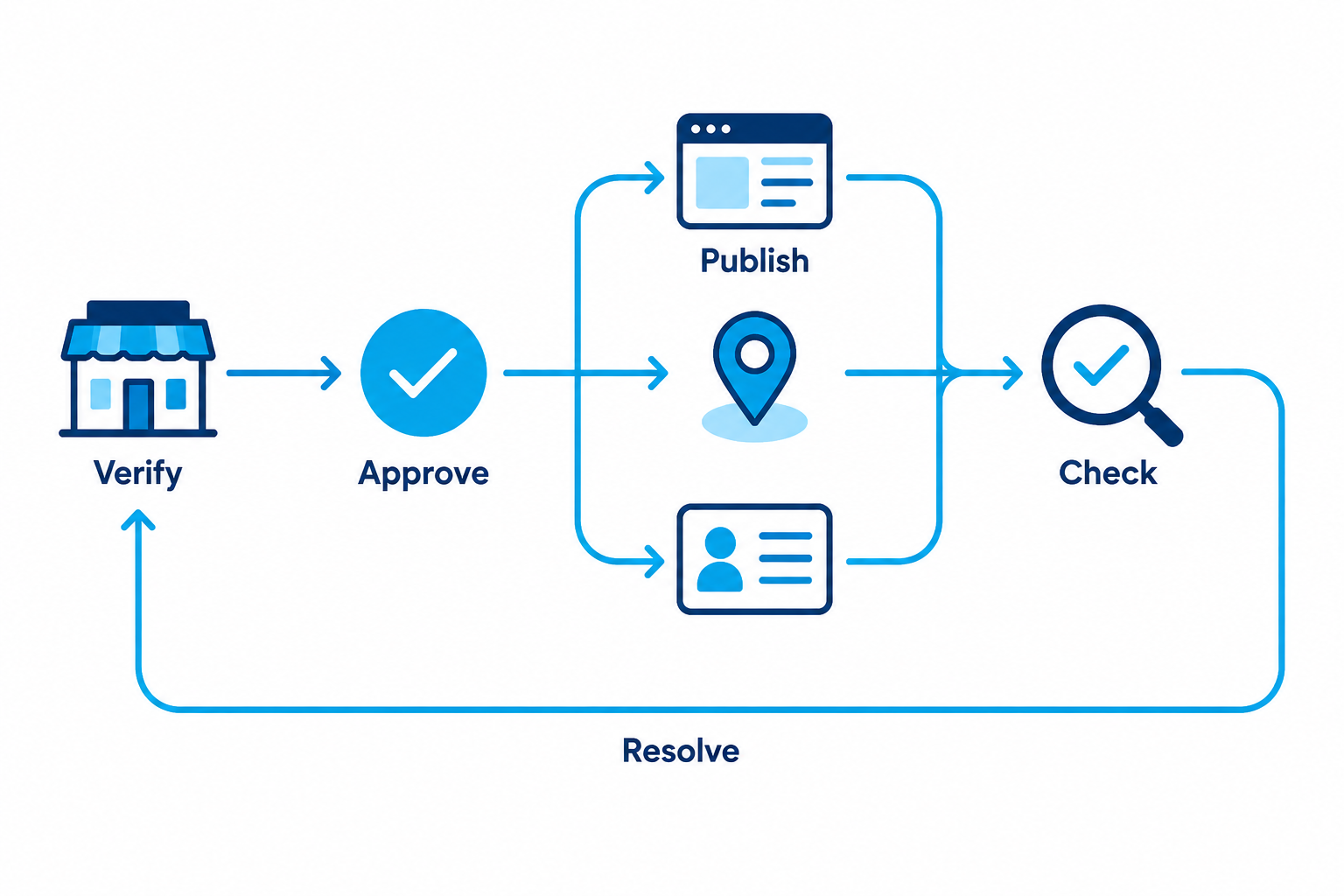
The practical extension is to manage the entire change cycle: who verifies a fact, who publishes it, and who checks the public result. A spreadsheet can support this process for a small business. More locations may justify a database or listings platform, but software cannot decide whether a branch is genuinely open or eligible for a profile.
What are customers trying to find in local searches?
Multi-location SEO helps customers find the appropriate branch through organic search and local results, including Google Maps. The objective is not simply to make the brand visible everywhere. It is to connect a specific need with a location that can fulfill it.
A search for “dentist near me” requires a relevant nearby practice. “Brand name Boulder hours” needs a clear branch answer. “Emergency plumber serving Longmont” may need a service-area business rather than a storefront. “Physical therapy office with accessible parking” requires details beyond an address.
Your content should reflect those differences. A location page answers where the branch is, what it offers, and how to become a customer. A service page explains the service in depth. A location directory helps people choose among branches. These pages should work together rather than compete to answer every possible query.
How do you build a reliable branch record?
Start with the locations that actually operate today, not the locations listed in an old marketing document.
- Inventory the footprint. List each operating branch, its location-page URL, Google Business Profile link, current status, and person responsible for confirming its details. Flag duplicates, closed branches, and planned openings separately.
- Assign a stable internal location ID. Keep it unchanged when a branch moves or changes managers. Use it to connect website records, analytics, and CRM reporting without relying on inconsistent branch names.
- Verify customer-facing facts with the branch. Confirm the real-world business name, address or service-area setup, phone, regular hours, special hours, services, appointment link, accessibility details, and opening status.
- Separate shared facts from local facts. Brand descriptions and design standards can be shared. Service availability, entrances, staff, hours, and booking destinations need branch-level verification.
- Record ownership and evidence. Store the approver, verification date, and source of important changes. Keep internal notes and customer-facing information in separate fields.
- Track publication by destination. A record marked approved is not necessarily live. Track whether the website, Google Business Profile, and priority directories have been updated and checked.
What makes a location page useful instead of repetitive?
A strong branch page helps someone decide whether that location is suitable and take the next step. Reusing a layout is sensible. Replacing only the city name in otherwise identical copy usually adds little value.
Include the branch’s accurate contact information, current hours, services available there, and a clear call or booking action. Add real visit details when relevant: parking, transit access, entrance instructions, accessibility features, and whether appointments are required. For businesses visiting customers, explain the service area without presenting an address as a walk-in office.
Original branch photography, verified staff information, and genuinely location-specific FAQs can make the page more useful. Do not manufacture local detail, invent testimonials, or claim every branch offers every service. There is no magic word count; completeness matters more than length.
Give each page a descriptive title and heading. A hypothetical title such as “Boulder Physical Therapy Office | Brand Name” is clearer than a list of surrounding cities. Link the page from a crawlable location directory and relevant service pages. Keep current pages accessible, indexable, and included in your normal website maintenance process.
LocalBusiness structured data can describe information such as the location’s address, telephone, and hours. It should match the visible page and use the appropriate business type. Structured data does not replace a Google Business Profile or guarantee enhanced search results. [Source: Google Search Central, “Local business structured data.”]
How should each Google Business Profile connect to the website?
For a business with distinct branches, link each profile to the corresponding useful location page rather than automatically sending everyone to the homepage. The destination should confirm that customers found the right branch and make their next action obvious.
Treat booking links separately. A correct location page does not help if its appointment button opens another branch’s calendar. Test the full journey on mobile: search result, page, call button, form, booking system, and confirmation.
Choose profile categories that accurately describe the business. Use shared category guidance where branches operate similarly, but allow legitimate differences. Avoid treating every available category as an optimization opportunity.
Keep real photos and hours current, and establish a consistent process for requesting honest reviews. Do not offer incentives or solicit only positive reviewers. Replies should be helpful without exposing private customer information; healthcare and other sensitive businesses need particular care.
What does this look like for a growing local business?
Consider a hypothetical physical therapy business with offices in Boulder, Louisville, and Longmont. They share a brand, but only the Boulder office offers a particular rehabilitation program. Louisville has different evening hours, and Longmont uses a separate booking calendar.
A weak rollout copies the Boulder page for every office, connects all profiles to the homepage, and lets customers discover the differences after they call. It may generate inquiries, but some will reach the wrong team or request an unavailable service.
A better system stores those differences in the branch records. The shared page template displays only verified services, hours, and booking links. Each profile leads to its own branch page. The service overview explains which locations offer the specialized program and links to them.
If Louisville changes its evening schedule, that change triggers updates to its page, profile, and relevant listings. Someone then checks the live information. This is not a claimed ranking result; it illustrates how an operational process prevents avoidable customer confusion.
How should location changes move from approval to publication?
Use a lightweight change process rather than relying on someone remembering every destination.
- Open a change request tied to the location ID. Record the old value, proposed value, effective date, and affected channels.
- Have an accountable person verify it. Routine hours changes and major relocations do not need the same review, but both need a reliable source.
- Update the approved branch record. Avoid disconnected edits that leave the website team and local manager working from different facts.
- Publish to the affected destinations. Account for platform review delays; a submitted edit is not necessarily a live edit.
- Check the public result. Verify the page, profile, map position when relevant, phone routing, and booking flow.
- Close the request with evidence. Record completion and any unresolved platform issue so the next team member can follow up.
Which problems should you fix first?
Prioritize errors that prevent customers from reaching the right business: inaccurate closure status, wrong phone numbers, broken booking links, incorrect hours, and misleading addresses. Resolve profile access and eligibility problems before polishing descriptions.
Next, address structural issues: duplicate profiles requiring investigation, missing location pages, conflicting service information, and branches that cannot be reached through website navigation. Expand useful local content after those foundations work.
Directory cleanup should be selective. Focus on platforms customers use, relevant industry directories, and listings with materially incorrect details. Identical punctuation everywhere is less important than making sure the business identity, contact information, and operating status are clear.
For a relocation or closure, use a specific plan rather than deleting everything. Update the profile status appropriately, explain the change on the website where useful, and route visitors to a genuinely relevant alternative. Do not redirect every closed branch page to an unrelated homepage simply to preserve traffic.
How do you measure performance without hiding weak branches?
Brand-wide totals can disguise local problems. Report by location before rolling results into an executive summary.
Separate visibility, customer actions, and business outcomes. Search Console can show organic impressions and clicks for location pages. Google Business Profile performance provides available profile interaction data. Website analytics records actions such as form submissions, while the CRM should identify qualified inquiries, booked appointments, and completed business where feasible.
Use consistent UTM parameters on profile website links and preserve the branch identifier through forms and booking systems. Test that attribution survives the handoff. If you use call tracking, follow applicable platform requirements and privacy rules, and verify routing. Do not send sensitive customer details into analytics URLs or event labels.
Distinguish the branch a customer first viewed from the branch that ultimately served them. Both may matter. Without that distinction, a busy office can appear to create demand that another office actually generated.
Compare each branch with its own history and account for seasonality, capacity, operating hours, and market differences. Google describes local ranking primarily in terms of relevance, distance, and prominence. A branch farther from a searcher cannot eliminate that distance through better descriptions. Local rank scans can support diagnosis, but they are not a substitute for qualified-lead measurement. [Source: Google, “Tips to improve your local ranking on Google.”]
Is each branch ready for a scalable local SEO program?
Use this checklist before expanding content production or purchasing a location-management platform.
- Each operating branch has a verified record, stable location ID, and accountable owner.
- Google Business Profile eligibility and authorized account access have been checked.
- Profiles and pages show accurate customer-facing names, hours, contact details, and services.
- Every branch page offers useful local information and is reachable through website navigation.
- Profile links, call buttons, forms, and appointment links reach the correct destination.
- Structured data matches visible branch information.
- Priority directories have been checked for materially incorrect or outdated facts.
- Review requests are neutral, and replies protect customer privacy.
- Analytics and CRM reporting can distinguish locations and qualified outcomes.
- Openings, moves, closures, and holiday hours have an approval and live-verification process.
What do business owners ask about multi-location SEO?
Do we need a separate website for each location?
Usually not for branches of the same business. A shared website with distinct, useful location pages is often easier to maintain. Separate domains may fit independently operated brands or other business requirements, but they add content, governance, and measurement complexity.
Can we create pages for cities where we do not have an office?
Yes, when the business genuinely serves those areas and the pages provide useful, accurate information. Clearly describe them as service areas rather than offices. Avoid producing interchangeable city pages that offer no meaningful help beyond forwarding visitors to the same destination.
Should branch managers control their own Google Business Profiles?
They should contribute verified local information, but the business should retain appropriate ownership and access oversight. Define who can approve sensitive changes, who handles routine updates, and how access is removed when staff leave.
When is listings-management software worth buying?
Consider it when frequent changes, numerous destinations, or limited staff make manual publishing unreliable. Evaluate field support, approval workflows, duplicate handling, reporting, and what happens when you cancel. Software is most useful after your underlying location data is trustworthy.
How long does multi-location SEO take to improve results?
There is no dependable universal timeline. Correcting a broken booking link can help customers once the fix is live, while search visibility depends on competition, proximity, site quality, profile status, and other factors. Set separate milestones for accurate publication, measurable customer actions, and longer-term search performance.
What should you remember?
- Scale verified branch information and clear ownership before scaling page production.
- Create profiles for eligible business locations, not every city you want to reach.
- Use shared templates while preserving real differences in services, hours, and customer journeys.
- Treat publication and public verification as separate tasks.
- Measure qualified outcomes by branch instead of relying only on brand-wide traffic or rankings.
Where is your location strategy losing customers?
Request a free marketing audit from Fecto Digital to review your location pages, Google Business Profile connections, and lead-tracking setup. Identify which branch-level issues deserve attention first and build a practical plan for managing growth.